
Cart
0
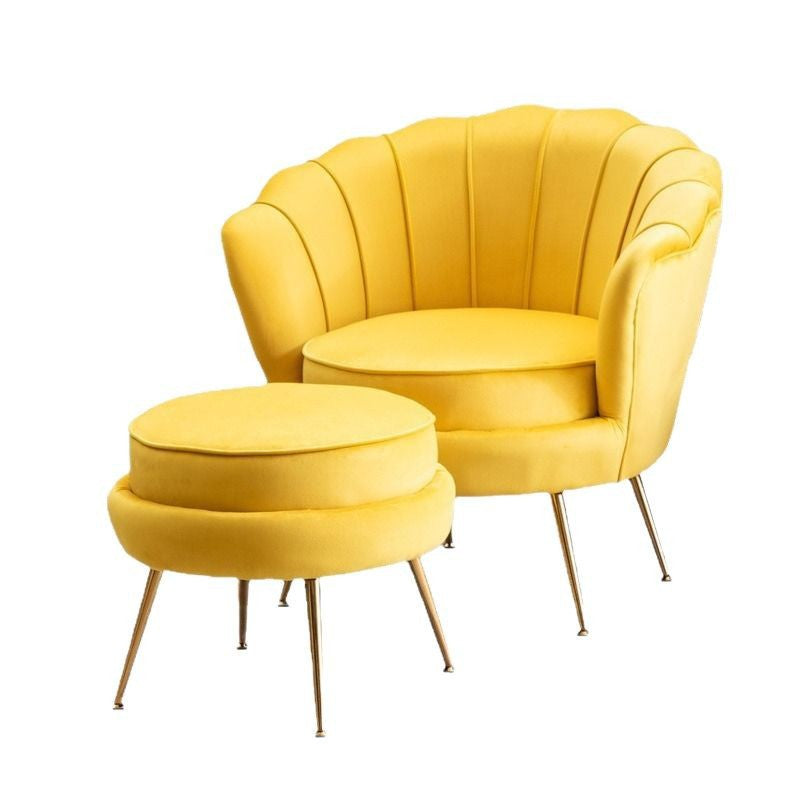
A barrel chair is a rounded, fully upholstered accent chair where the back and sides curve continuously from armrest to armrest in a single arc — resembling the curved stave of a barrel. Standard dimensions: 28–32 inches wide, 20–22 inches seat depth, 17–18 inches seat height, 30–34 inches total back height. The enclosed shape creates visual enclosure and works best as a living room focal point or conversation chair in open-plan spaces.
Where the Name Comes From
The name "barrel chair" comes from the shape of a wooden barrel stave — the curved wooden plank that forms the rounded side of a barrel. When viewed from above, a barrel chair's back describes the same arc as one section of a barrel: a smooth, unbroken curve from one side to the other. The chair does not look like a barrel — it borrows the barrel's defining geometric property: continuous curvature with no flat back panel.
This distinguishes it immediately from:
- A standard armchair — flat back panel, visible separation between back and arms
- A wingback chair — flat back panel with two angled side wings attached separately
- A club chair — flat or slightly curved back with separate arm padding visible at the join
In a barrel chair, the back flows directly into the arms with no visible seam, joint, or frame gap at the transition point.
Barrel Chair Dimensions (Standard)
| Measurement | Standard Range |
|---|---|
| Overall width | 28–32 inches |
| Overall depth | 28–34 inches |
| Seat width | 20–24 inches (narrower than overall — the curve reduces usable seat width) |
| Seat depth | 20–22 inches |
| Seat height | 17–18 inches |
| Back height (from floor) | 30–34 inches |
| Arm height | 24–27 inches |
Important dimension note: The overall width of a barrel chair (28–32 inches) is wider than its usable seat width (20–24 inches). The curved back and arms consume 4–8 inches of the chair's total footprint. A buyer selecting a barrel chair based on overall width will find the seated space narrower than expected — this is the most common sizing mistake with this chair type.
Floor clearance required: Barrel chairs need 38–44 inches of total width clearance including circulation space on both sides. The curved shape means the visual footprint reads wider than the measured width — allow at least 6 inches of breathing room on each side in a room layout.
How a Barrel Chair Is Constructed
The continuous curve of a barrel chair's back is the most structurally demanding feature of any standard accent chair type. Building a back that transitions smoothly into the arms — with no visible seam — requires an internal frame that can hold a compound curve under sustained upholstery tension and seated load.
Frame Requirements
A barrel chair frame must solve two structural problems that flat-back chairs do not face:
Problem 1 — Holding the curve shape. A curved back frame carries lateral stress at every point along the arc. Straight-back chair frames carry load primarily in compression (downward). A curved frame carries load in both compression and lateral bending. Kiln-dried hardwood with moisture content controlled below 12% resists this lateral stress without deforming. Frames built from green or unseasoned wood, or from engineered wood composites, develop visible shape distortion — the curve flattens slightly — within 18–24 months of regular use.
Problem 2 — Maintaining the arm-to-back transition. The joint where the arm meets the back is the highest-stress point in a barrel chair frame. This joint carries the load of the user leaning into the side of the chair — a common seated behavior in an enclosed, enveloping chair. Frames with a single dowel or simple butt joint at this transition develop looseness within 12 months. Frames using corner blocks, mortise-and-tenon joints, or metal bracket reinforcement at this junction maintain structural integrity for 5–8 years under residential use.
Upholstery Requirements
The continuous curved surface of a barrel chair requires skilled upholstery cutting and fitting. Fabric must be cut and laid to follow the curve without puckering at the arm-to-back transition. This is more labor-intensive than upholstering a flat-back chair — it is one reason barrel chairs carry a higher production cost than equivalent-size standard armchairs.
Fabric with directional weave (velvet, corduroy, boucle with visible pile direction) requires careful orientation across the curve — a mismatch in pile direction at the arm-to-back join is visible and reads as a production defect. Non-directional fabrics (performance fabric, tight-woven linen, leather) are easier to apply cleanly across a compound curve.
Barrel Chair vs Other Accent Chair Types
Barrel Chair vs Standard Armchair
A standard armchair has a flat back panel and visible separation between the backrest and the arms. The seated experience is upright and open — the user's peripheral vision is not enclosed. A barrel chair's curved sides create partial visual enclosure — the user is aware of the chair's presence on both sides, which many people find more enveloping and comfortable for extended seated use.
Choose a barrel chair over a standard armchair when: the room needs a strong focal point, the seating zone is in an open-plan space that benefits from defined enclosure, or the user prefers an enveloping seated experience.
Choose a standard armchair over a barrel chair when: the room is small (the barrel's perceived width reads heavy in tight spaces), the design direction is minimal or Scandinavian, or cost is a constraint (standard armchairs carry lower production costs).
Barrel Chair vs Wingback Chair
Both chair types create visual enclosure — the barrel chair through its curved sides, the wingback through its tall back and forward-extending wings. The key differences:
- Back height: barrel chairs sit at 30–34 inches; wingback chairs at 40–50 inches
- Room scale requirement: barrel chairs work in rooms with 8-foot ceilings; wingback chairs need 9 feet or above
- Design direction: barrel chairs read as contemporary-to-transitional; wingback chairs read as traditional-to-formal
- Enclosure type: barrel chairs enclose laterally (sides); wingback chairs enclose vertically (height) and partially laterally (wings)
Barrel Chair vs Club Chair
Club chairs and barrel chairs both create an enveloping seated experience, but through different structures. A club chair uses separate, deeply padded flat arms — the enclosure comes from arm height and padding volume. A barrel chair uses a continuous curved back — the enclosure comes from the geometry of the frame.
Club chairs are wider (32–38 inches vs 28–32 inches for barrel) and have deeper seats (22–26 inches vs 20–22 inches). Barrel chairs are more compact and read as more refined visually — the clean arc of the back creates a tighter, more intentional silhouette than the boxy volume of a club chair.
Where Barrel Chairs Work Best
Living Room Focal Point
A barrel chair placed at a 45-degree angle to a sofa — rather than directly facing it — creates a dynamic conversation arrangement in a living room. The curved back reads well from multiple angles, unlike a flat-back armchair that reads as flat and uninteresting from the side. In open-plan living-dining spaces, a barrel chair's enclosed shape creates a visual boundary for the seating zone without requiring a physical divider.
Hotel Lobby and Lounge Seating
Barrel chairs are a common specification for hotel lobbies, private club lounges, and boutique hotel common areas. The enclosed shape creates semi-private seating zones within open communal spaces — a guest seated in a barrel chair has partial visual separation from the surrounding area without the full enclosure of a pod chair. This semi-private quality makes barrel chairs effective in hotel lobbies where guests need brief seated rest between interactions with staff.
Bedroom Sitting Area
In master bedrooms with a dedicated sitting corner, a barrel chair in 28–30 inches width fits without consuming excessive floor space. The enclosed back reads as intentional and finished — more so than a standard armchair, which can look incidental in a bedroom context.
What to Avoid
Barrel chairs underperform in:
- Small rooms under 130 sq ft — the visual mass and minimum 38-inch clearance requirement crowds the space
- Long, narrow rooms — the circular silhouette sits awkwardly in a rectangular plan where linear furniture reads better
- Minimalist interiors with no focal point — the barrel chair's strong silhouette demands visual context; in a stripped-down space it reads as the only statement piece, which works only if that is the intent
How Penghao Furniture Manufactures Barrel Chairs
Penghao Furniture produces barrel chairs factory-direct in China, with export to the US and Europe.
Frame: Kiln-dried solid hardwood frame with moisture content controlled below 12%. The arm-to-back junction uses corner block reinforcement and mortise-and-tenon joinery at the curved transition — the highest-stress point in barrel chair construction. This joint specification prevents the looseness that develops in barrel chairs built with simpler dowel-only connections.
Upholstery: Fabric is cut and applied by skilled upholsterers trained in compound-curve fitting. Pile direction on directional fabrics (velvet, boucle) is confirmed and matched across the full curve before cutting. Non-directional performance fabrics are available for commercial applications requiring easier cleaning and higher abrasion resistance.
Foam: Seat cushions at 35–40 kg/m³ for commercial or daily residential use. The barrel chair's enclosed shape means seat heat retention is higher than open-sided chairs — breathable performance fabrics and foam with open-cell structure are recommended for warm climates or extended daily use.
Customization: Curve radius (tighter or wider arc), overall width, seat depth, fabric, and leg finish are adjustable per OEM order. Custom barrel chair specifications — including larger-scale versions for hotel lobby use — are available from 10–50 units MOQ.
Lead time: 15–45 days from confirmed specification. Cost: 20–40% below equivalent US retail pricing for the same frame and foam specification.
A New York-based interior design studio specifying barrel chairs for 12 boutique hotel suites ordered 36 units from Penghao Furniture factory-direct — custom boucle upholstery, walnut leg finish, 35 kg/m³ seat foam — at 27% below the equivalent US wholesale price for the same specification.
FAQ
What is a barrel chair?
A barrel chair is an upholstered accent chair with a continuously curved back that arcs from one armrest to the other with no visible seam or gap at the arm-to-back transition. The continuous curve — resembling the arc of a barrel stave — is the defining structural feature. Standard dimensions: 28–32 inches wide, 20–22 inches seat depth, 17–18 inches seat height, 30–34 inches back height from floor.
Why is it called a barrel chair?
The name comes from the shape of a wooden barrel stave — the curved plank that forms the rounded side of a barrel. When viewed from above, a barrel chair's back describes the same continuous arc as one section of a barrel. The chair does not resemble a barrel in overall appearance — it borrows the barrel's defining geometric property: unbroken curvature from one edge to the other.
What is the difference between a barrel chair and a club chair?
A barrel chair uses a continuously curved back that arcs smoothly into the arms — the enclosure comes from the geometry of the frame. A club chair uses separate, deeply padded flat arms with a flat or slightly curved back — the enclosure comes from arm height and padding volume. Club chairs are wider (32–38 inches) and have deeper seats (22–26 inches) than barrel chairs (28–32 inches wide, 20–22 inches seat depth). Barrel chairs read as more refined visually; club chairs read as heavier and more casual.
Are barrel chairs comfortable?
Barrel chairs are comfortable for sessions of 30–60 minutes in an upright seated position. The enclosed curved sides create an enveloping feel that many users find more comfortable than open-sided armchairs for conversation or alert rest. For sessions over 60 minutes requiring passive rest, a lounge chair with a reclined back angle (100–115 degrees) provides better sustained comfort. The barrel chair's seat angle is 90–100 degrees — upright, not reclined.
What size room does a barrel chair work best in?
Barrel chairs work best in rooms of 150 sq ft or above. The chair requires 38–44 inches of width clearance including circulation space on both sides. In rooms under 130 sq ft, the visual mass of the curved back reads as heavy and space-consuming. For small rooms, a slipper chair (22–28 inches wide, armless) or a compact accent armchair (26–28 inches wide) is a more proportionate choice.
Can barrel chairs be used in commercial environments?
Yes barrel chairs are a common specification for hotel lobbies, private lounges, boutique hotel suites, and high-end office common areas. Commercial use requires seat foam at 35–40 kg/m³ (maintains shape under daily use for 3–5 years) and upholstery fabric rated at 50,000+ rub cycles. Performance fabric or tight-woven commercial-grade textile is preferred over velvet for high-traffic commercial applications.
Summary
A barrel chair is an accent chair defined by one structural feature: a continuously curved back that arcs from armrest to armrest with no visible seam at the arm-to-back transition. Standard dimensions are 28–32 inches wide, 20–22 inches seat depth, 17–18 inches seat height, 30–34 inches back height.
The continuous curve demands a higher-specification frame than flat-back chairs — kiln-dried hardwood with reinforced joinery at the arm-to-back junction is the minimum for chairs that need to hold their shape and structure beyond 2–3 years of regular use.
Barrel chairs work best as living room focal points, hotel lobby seating, and bedroom sitting-corner chairs in rooms with 150 sq ft or above and ceiling heights of 8 feet or higher.
Penghao Furniture manufactures barrel chairs factory-direct with OEM customization for curve radius, fabric, foam density, and leg finish. MOQ starts at 10 units. Lead time is 15–45 days.