
Cart
0
Updated August 2026
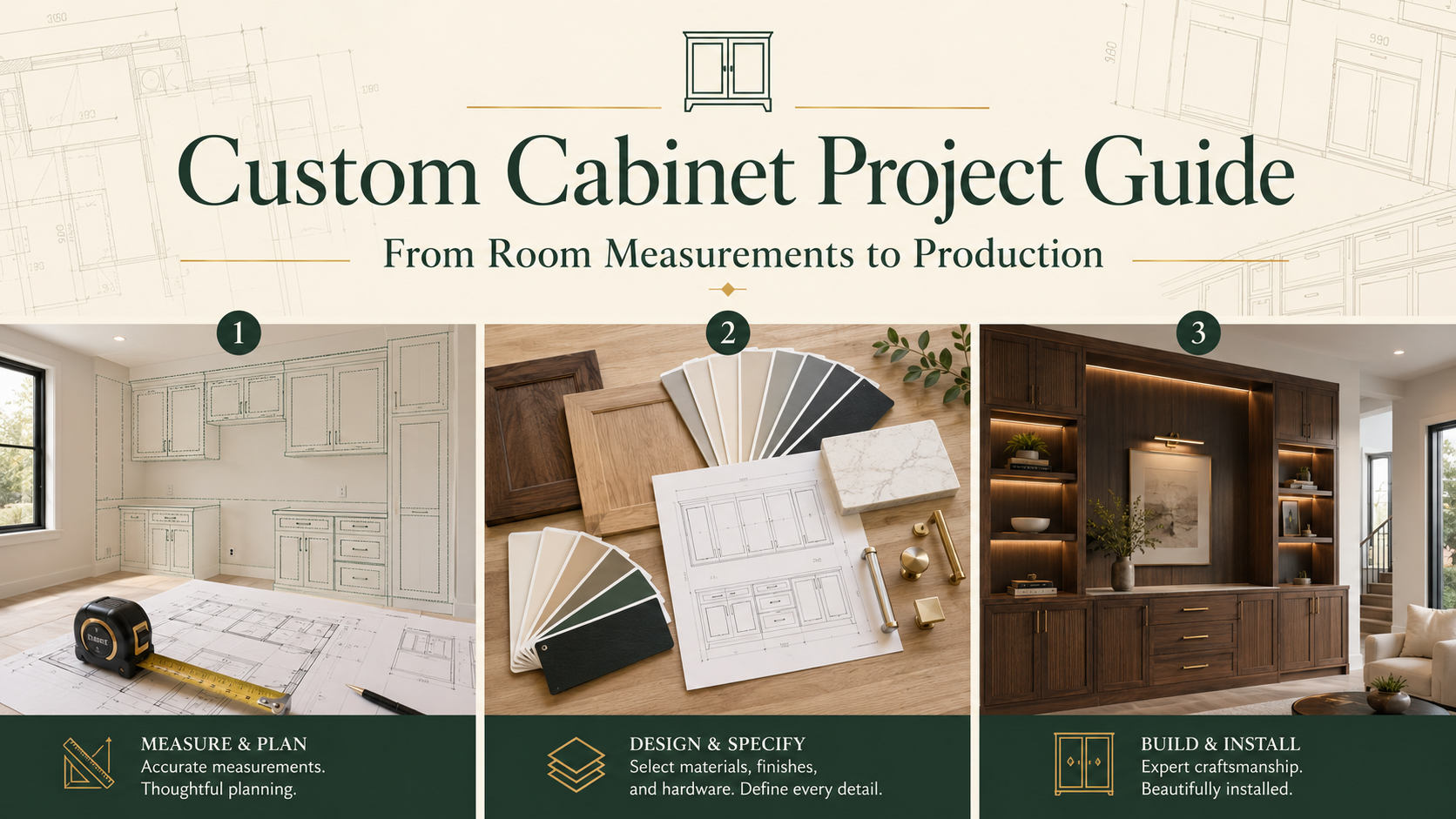
A custom cabinet project succeeds or fails before the factory cuts the first panel. The most important work happens in measurements, storage planning, drawings, material decisions, hardware choices, finish approval, and installation assumptions.
Cabinetry is unforgiving because it meets the building. A sofa can move slightly. A chair can be replaced. A cabinet has to fit walls, floors, doors, outlets, ceilings, pipes, lighting, and daily use. When the specification is vague, even a skilled factory has to guess.
This guide is written for designers, developers, hotel owners, apartment operators, villa project buyers, and importers planning wardrobes, closets, storage cabinets, vanity units, dressing rooms, or built-in furniture with a custom cabinet manufacturer.
What is a custom cabinet project?
A custom cabinet project is a made-to-measure cabinetry order developed around a real space, storage behavior, materials, hardware, finish, and installation conditions. It usually requires site measurements, drawings, material confirmation, sample approval, and production-ready details before manufacturing.
Penghao fits buyers who need cabinetry connected to the whole furnishing plan. The Custom Cabinet Solutions page positions the service around cabinet geometry, storage behavior, material details, hardware, drawings, and production information confirmed in advance.
Why standard cabinet dimensions often fail in project spaces
Standard cabinets can work when the room is simple, the buyer accepts fixed sizes, and installation flexibility is high. Project spaces are different. Hotels, villas, apartments, salons, offices, and commercial rooms usually have design intent, wall constraints, material matching, delivery timing, and multi-room consistency requirements.
The problem is not only size. It is interaction. A wardrobe door must open without hitting a bed. A drawer must clear a nightstand. A dressing table must align with mirror and lighting. A storage cabinet must work with the user's real habits. A cabinet that fits the wall but fails daily use is not a successful cabinet.
If cabinetry includes MDF, particleboard, plywood, veneer, or laminated components for the U.S. market, the U.S. EPA's formaldehyde emission standards for composite wood products should be checked early. Material choice can affect compliance documentation, labeling, and import responsibilities.
Step 1: Measure the space like production depends on it
Good measurements include more than width, height, and depth. They capture the physical behavior of the room.
Record:
- Wall-to-wall width at top, middle, and bottom
- Floor-to-ceiling height in multiple positions
- Wall angle, uneven surfaces, and skirting board conditions
- Door swing, window opening, and traffic direction
- Outlet, switch, pipe, vent, and lighting positions
- Elevator, corridor, stair, and room-entry constraints
- Installation tolerance and on-site assembly requirements
For large projects, create one measurement template for every room type. If rooms repeat, verify whether they are truly identical. A 20 mm variation can affect cabinet installation, door gaps, filler strips, and final appearance.
Step 2: Define storage behavior before exterior style
Cabinetry should be designed around what people actually store and how often they access it. Exterior style matters, but storage logic determines whether the cabinet feels intelligent after installation.
For wardrobes, define hanging height, folded storage, drawers, luggage space, lighting, mirrors, lockable sections, and seasonal storage. For dressing rooms, think about visibility, movement, sitting position, mirror placement, and accessory storage. For hotel rooms, cleaning access and replacement parts matter. For apartments, compact storage and daily durability often matter most.
Penghao's cabinetry page frames this well: the service treats cabinet geometry, internal organization, materials, finishes, hardware, and drawings as one connected process. That is the right way to approach custom cabinetry.
Step 3: Choose materials for use, appearance and market requirements
Cabinet materials should be selected around budget, finish quality, expected use, installation environment, and destination market.
| Material or component | Common use | What to verify |
|---|---|---|
| MDF or particleboard | Carcasses, doors, shelves, laminated cabinets | Grade, thickness, surface finish, formaldehyde documentation |
| Plywood | Stronger panels, structural parts, moisture-sensitive areas | Core quality, veneer, flatness, edge treatment |
| Solid wood or veneer | Premium doors, visible details, luxury finishes | Color variation, moisture behavior, finish consistency |
| Hardware | Hinges, slides, handles, locks, lift systems | Load rating, soft close, replacement availability |
| Stone or glass | Vanity tops, display sections, premium accents | Weight, edge safety, breakage protection |
| LED or smart features | Wardrobes, bedside cabinets, vanity stations | Voltage, certification, wiring route, serviceability |
For international buyers, material compliance should be part of the RFQ. The U.S. EPA notes that importers may need to certify TSCA compliance through customs processes for applicable chemical or regulated article requirements. Buyers should ask suppliers what documentation can be provided before confirming the design.
Step 4: Turn design intent into production drawings
Images and renderings are not enough for custom cabinetry. The factory needs production drawings that define dimensions, materials, hardware, edge treatments, internal layout, door gaps, joining methods, finish references, packaging, and installation notes.
A useful drawing package includes:
- Plan view showing the cabinet position in the room
- Elevations showing all visible fronts
- Section drawings showing depth and internal organization
- Material schedule
- Hardware schedule
- Finish references
- Installation notes
- Packaging and labeling requirements
If a buyer cannot provide complete drawings, the supplier should help convert the brief into a controlled specification before quoting final production.
Step 5: Approve samples and material boards
A full cabinet sample is not always necessary, but material boards and critical detail samples often are. For example, buyers may need to approve a door panel, edge banding, handle, hinge, drawer slide, laminate, veneer, stone, fabric insert, or lighting component.
The sample file should record:
- Drawing version
- Material code
- Finish reference
- Hardware model
- Edge detail
- Door gap and tolerance
- Packaging note
- Approval date and buyer comments
This becomes the reference for bulk production and future repeat orders.
Custom cabinet RFQ checklist
| RFQ item | Why it matters |
|---|---|
| Room measurements | Prevents size and installation mistakes |
| Floor plans and elevations | Shows how cabinets relate to architecture |
| Storage requirements | Turns the cabinet into a usable system |
| Material and finish direction | Controls cost, appearance, and compliance |
| Hardware expectations | Affects daily use and long-term service |
| Destination market | Helps identify documentation needs |
| Quantity by room type | Supports production planning and price accuracy |
| Installation method | Determines packaging, labels, and assembly logic |
| Delivery terms | Clarifies buyer and seller responsibilities |
For international projects, use Incoterms 2020 terminology when discussing FOB, CIF, DDP, or other delivery terms. This prevents quote comparisons from mixing product price, freight responsibility, insurance, duty, and final delivery in confusing ways.
How Penghao can support custom cabinetry
Penghao's custom cabinet offer is strongest when the cabinet is part of a wider interior package. A hotel suite, villa, apartment, salon, office, or residential development may need cabinetry, beds, dining sets, soft furnishing coordination, and custom furniture produced with one visual language.
Useful Penghao pages:
- Custom Cabinet Solutions for bespoke cabinetry planning
- Soft Furnishing Matching Services for whole-interior coordination
- Custom Furniture Manufacturing for OEM/ODM development
- Manufacturing Strength for production capability context
- Factory Tour for process and material selection positioning
FAQ
What information is needed for a custom cabinet quote?
A useful custom cabinet quote needs measurements, drawings, room photos, storage requirements, materials, finish direction, hardware expectations, quantity, destination market, installation method, and delivery terms. Without these details, suppliers may quote different products under the same name.
Are custom cabinets better than standard cabinets?
Custom cabinets are better when the space has unusual dimensions, brand-specific style, complex storage needs, or multi-room consistency requirements. Standard cabinets may be faster and cheaper when the project can accept fixed sizes.
How can buyers avoid custom cabinet production mistakes?
Buyers should confirm measurements, drawings, materials, hardware, finish samples, edge details, packaging, and installation notes before production. The supplier should record the approved standard in writing.
What materials are common in project cabinetry?
Common materials include MDF, particleboard, plywood, veneer, solid wood, laminate, metal hardware, glass, stone, and LED components. The best choice depends on budget, use environment, finish expectation, and destination market.
Can Penghao make custom cabinets for hotels or apartments?
Penghao offers custom cabinet solutions for wardrobes, closets, dressing rooms, integrated storage, and project interiors. Buyers should send room measurements, plans, photos, material references, quantity, and delivery market for review.
Final thought
Custom cabinetry is architecture, storage, furniture, and manufacturing combined. The more precisely you define the room, behavior, material, hardware, finish, and installation logic, the fewer decisions the factory has to guess. For hotel, apartment, villa, or commercial cabinet projects, prepare the measurement file first, then ask Penghao to turn it into a manufacturable cabinet specification.
Sources used in this guide
- Penghao Furniture, Custom Cabinet Solutions
- Penghao Furniture, Custom Furniture Manufacturing
- Penghao Furniture, Factory Tour
- U.S. EPA, Formaldehyde Emission Standards for Composite Wood Products
- U.S. EPA, TSCA Requirements for Importing Chemicals
- ICC, Incoterms 2020
